Table of Contents
Every guitarist who's any good started exactly where you are right now. Are you confused about which guitar to buy? Unsure if the fingers will ever cooperate? And wondering whether you should just pay for lessons or try to figure it out on your own?
Learning guitar online has become the default path for most beginners today, and it works, provided you approach it the right way. This guide covers the entire starting point: choosing your instrument, understanding the basics, and the actual mechanics of playing your first chords and strumming patterns.
Choosing Your First Guitar
Before anything else, you need an instrument that actually suits how you want to play.
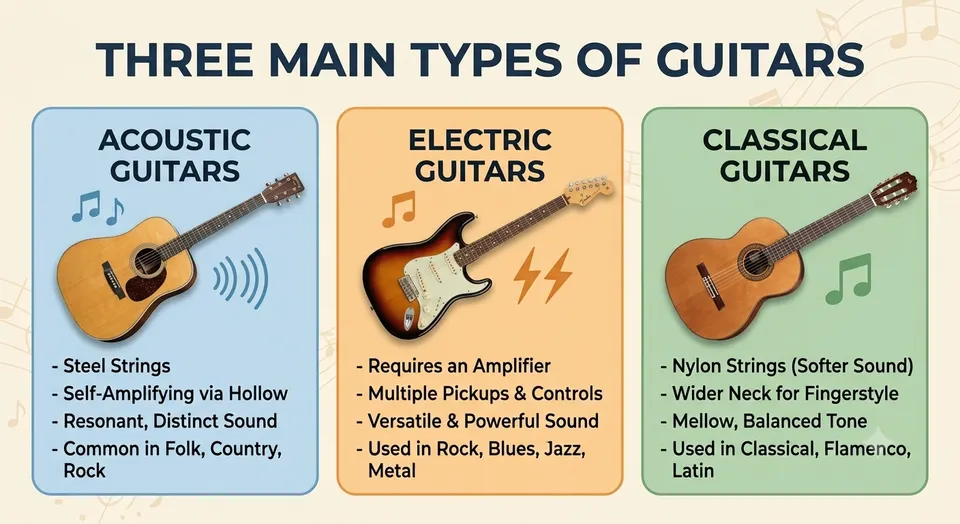
There are three main types of guitars, and each one serves a different purpose.
Acoustic guitars are the most versatile starting point. They're well-rounded, require no additional equipment, and work for folk, country, pop, and a wide range of other styles. If you're not sure what direction you want to take your playing, acoustic is the safest first choice.
Electric guitars are built for rock, blues, and anything that benefits from amplification and tonal shaping. They require an amp to sound the way you expect, which adds to the initial cost, but they're also generally easier on the fingers since the strings sit lower and require less pressure to fret cleanly.
Classical guitars use nylon strings rather than steel, producing a softer, warmer tone. They're the standard choice for classical and Spanish-style music, and the nylon strings are gentler on fingertips that haven't built up calluses yet.
Size matters as much as type. Guitars range from compact travel-sized models to full dreadnought bodies. If you're smaller in frame or have shorter arms, a smaller-bodied guitar or a 3/4 size model will feel considerably more comfortable than forcing yourself onto a full-size dreadnought. The best approach, where possible, is to physically hold a few different sizes before buying.
How to Learn Guitar Online: Your Options
Once you've got an instrument, the next decision is how you're actually going to learn. There are a few credible paths, and they're not mutually exclusive.
Structured Online Guitar Course
An online guitar course with a real curriculum gives you a clear progression instead of leaving you to figure out what to learn next. Good courses sequence material logically, building from open chords to basic strumming, then into more complex chord changes and eventually fingerpicking or lead technique.
The advantage here is structure. You're not guessing what to practise. Someone with experience has already worked out the most efficient order to learn things in, and you're going to follow that path.
1-on-1 Live Instruction
This is the closest equivalent to traditional in-person lessons, just delivered over video call. A real instructor watches your hand position, corrects your form in real time, and adjusts the pace based on how you're actually progressing, not how a generic course assumes you'll progress.
For most beginners, this is the fastest way to avoid building bad habits early on, since the kind of mistakes that are hard to unlearn (poor hand posture, tension in the fretting hand) are exactly the things a live instructor catches immediately, and a pre-recorded course can't.
Guitar Tutorial Videos
Free guitar tutorial content on platforms like YouTube can supplement structured learning well, especially once you know specifically what you want to work on. Want to learn a particular strumming pattern, or understand a specific chord shape better? A targeted tutorial video can clarify that quickly.
The limitation of the tutorials is that they don't know your specific playing. They can't see that your thumb is creeping over the top of the neck or that you're pressing far harder than necessary. Use them as a supplement to structured learning, not a replacement for it.
Self-Teaching Through Books and Practice
It's possible to learn guitar without any external instruction at all, using method books and consistent self-directed practice. It's the slowest path for most people, agreed, but it's the one most likely to result in technical habits that need correcting later. It works for a small number of highly disciplined, methodical learners.
Whichever path you choose, the meaningful difference between people who actually learn guitar and people who give up isn't talent. It's consistency.
How to Learn Guitar at Home: Setting Yourself Up Right
Once you've decided how you'll learn, getting your home practice environment right makes a measurable difference in how quickly you progress.
- Choose a comfortable spot with a chair that supports good posture.
- Keep your guitar nearby so it’s easy to pick up and practice.
- Practice 15–20 minutes daily instead of long sessions once a week.
- Focus on consistency to build muscle memory and improve faster.
- Avoid distractions during practice to stay focused.
- Set small weekly goals like learning a new chord or completing a song.
Basic Guitar Terminology Every Beginner Needs
A few terms come up constantly once you start learning, and understanding them early saves a lot of confusion later.
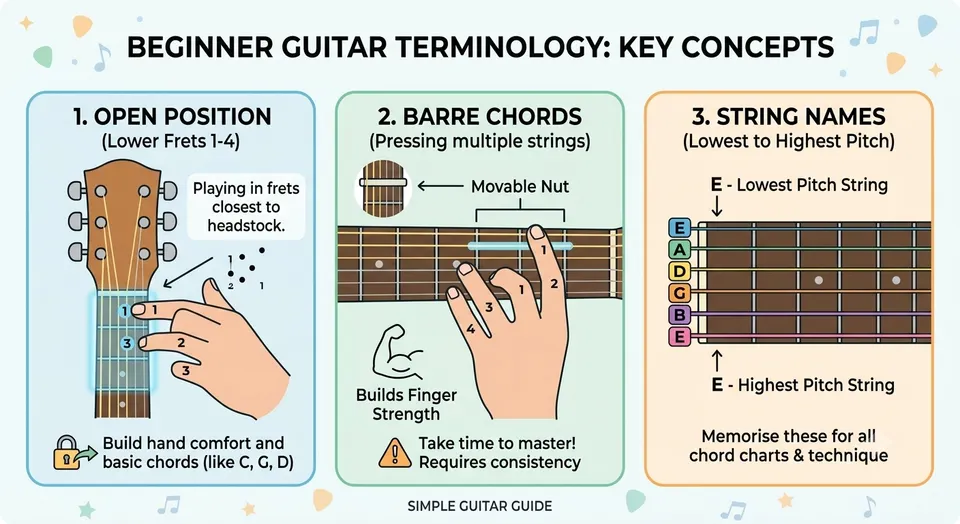
An open position refers to playing in the lower frets, generally the first four frets closest to the headstock. Most beginner chords and exercises live here, and it's the most natural hand position to start building comfort in.
Barre chords require your index finger to press down multiple strings across a single fret simultaneously, essentially acting as a movable nut. They're genuinely difficult for beginners and require finger strength that takes time to build. Don't be discouraged if these take weeks longer to feel comfortable than your other chords.
String names, from lowest to highest pitch, are E, A, D, G, B, and E. Memorising these isn't optional. Every chord chart, every tutorial, every conversation about technique assumes you know which string is which.
Common Guitar Chords to Start With
A small handful of chords will let you play an enormous number of songs once you've got them down.
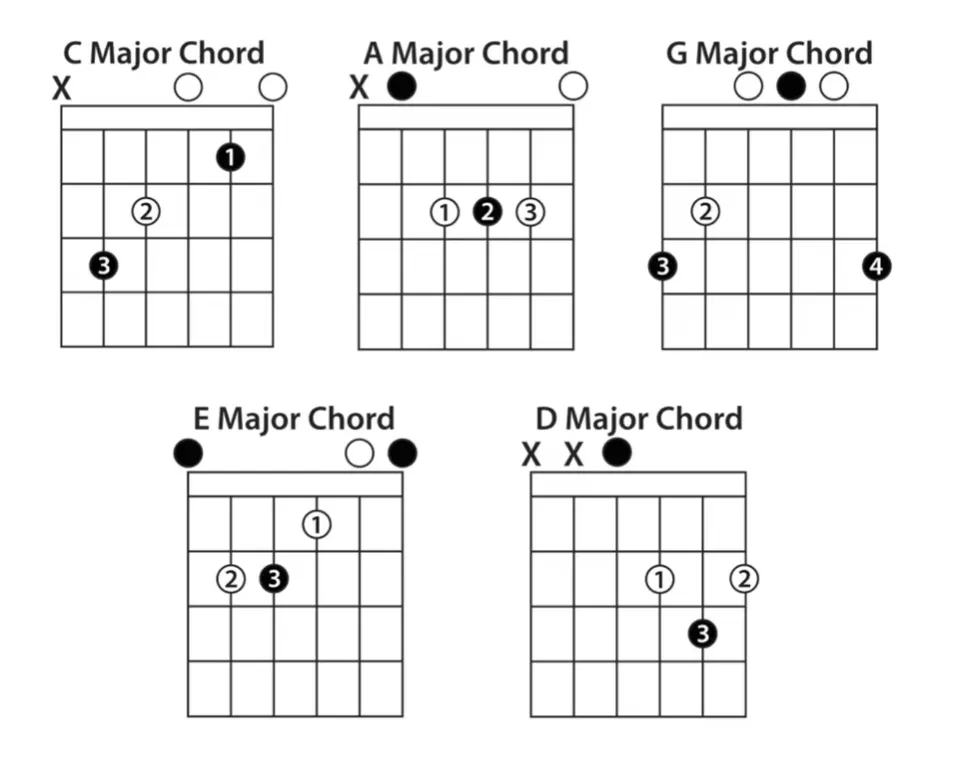
A major is formed by placing your index finger on the second fret of the D string, your middle finger on the second fret of the G string, and your ring finger on the second fret of the B string. The low E string is typically left unplayed or muted, and you strum from the A string downward.
D major uses your index finger on the second fret of the G string, your middle finger on the third fret of the high E string, and your ring finger on the second fret of the B string. Only the bottom four strings are strummed.
G major, C major, and E major round out the most commonly taught beginner chord set. Together with A and D, these five chords form the backbone of an enormous portion of popular music across genres.
Don't rush to memorise all five at once. Learn one cleanly, get comfortable transitioning into and out of it, then add the next.
How to Strum a Guitar Properly
Strumming technique gets overlooked by a lot of beginners who focus entirely on chord shapes, but a clean strumming hand matters just as much.
The standard starting pattern is a simple down-up motion. Hold your pick firmly but not rigidly between your thumb and index finger. Starting from above the strings, brush downward in one fluid motion, then bring the pick back upward in a separate, lighter motion. Repeat this consistently to build a steady rhythmic foundation.
Once that feels natural, branch into patterns like down-down-up-up or down-up-down-up-down, varying the rhythm to match different songs. Adding accents, hitting certain strums slightly harder than others, gives your playing dynamic variation rather than a flat, mechanical sound.
The biggest mistake beginners make here is tensing the strumming arm. Keep your wrist loose. The motion should come from a relaxed forearm and wrist, not a stiff, locked-up arm.
Learning Guitar Online vs In-Person: Does It Actually Work?
This question comes up constantly, and the honest answer is something that you will be able to figure out from the comparison below:
Learn Guitar Online With Spardha
At Spardha School of Music, our guitar curriculum is built specifically for beginners who want real structure, not generic content thrown at every student regardless of level.
Our certified instructors run live, 1-on-1 online classes that adapt to your specific pace and goals. Whether you want to play acoustic folk songs, learn classic rock riffs, or eventually move into fingerstyle or lead guitar, our structured pathway takes you from your very first chord to genuine musical competence.
If you've been searching for how to learn guitar online in a way that actually sticks, this is built for exactly that. No generic video library. Real instruction, tailored to you.
Book a free trial class today and play your first chord with someone watching to make sure you're doing it right.
Conclusion
Learning guitar isn't about finding some secret shortcut. It's about consistent practice, a sensible learning structure, and enough early guidance to avoid building habits you'll have to unlearn later. Whether you choose a structured online guitar course, live 1-on-1 instruction, or a mix of free guitar tutorial content alongside disciplined self-practice, the fundamentals stay the same.
Pick the right guitar. Learn the basic chords properly. Practise consistently, even in short sessions. Within a few months, you'll be playing songs you actually recognise, and that's when guitar stops feeling like homework and starts feeling like the thing you look forward to each day.
Frequently Asked Questions
How long does it take to learn guitar online as a complete beginner?
Most beginners can comfortably play simple songs using basic open chords within two to three months of consistent practice, roughly 15 to 20 minutes daily. Becoming genuinely proficient takes longer, often a year or more, but early wins come faster than most people expect.
Is it better to learn guitar online or in person?
Both work well, provided the format includes real-time feedback. Live, 1-on-1 online instruction offers the same correction and personalisation as in-person lessons, with significantly more flexibility around scheduling and instructor choice.
What's the best way to learn guitar at home without a teacher?
Structured method books combined with disciplined daily practice can work, but it's the slowest path and the most likely to result in technical habits that need correcting later. A structured online course or occasional check-ins with an instructor significantly speed up progress.
Do I need an expensive guitar to start learning?
No. A reasonably well-made beginner guitar, whether acoustic, electric, or classical, is sufficient for the first year or more of learning. What matters more than price is that the guitar is properly set up and comfortable to hold.
How many chords do I need to know to play songs?
A surprising number of popular songs use just four or five chords. Learning A, D, G, C, and E major thoroughly will let you play a substantial portion of common acoustic and pop repertoire.
Can guitar tutorial videos replace a structured course?
They work well as a supplement, especially for clarifying a specific technique or chord shape. But they can't see your hand position or correct your form, which means relying on them exclusively often leads to undetected bad habits.
What should I look for in a good online guitar course?
Look for clear progression from basics to more advanced material, real instructor interaction rather than purely pre-recorded content, and a structure that matches your specific goals, whether that's casual songwriting, classical technique, or lead guitar work.