Table of Contents
Hi, future singer, we're really glad you’re here.
Let’s be honest for a second. Learning singing can feel frustrating at the beginning. You try to hit a note… and it just doesn’t land. You listen to your own voice and wonder, “Do I even sound good?”
And if you’ve ever thought, “Maybe I’m just not born with a good voice”. You’re not alone. But here’s the truth most people don’t tell you: No one is born a perfect singer. Good singers are built, not born.
With the right approach, consistent practice, and a little patience, you can absolutely improve your voice.
This guide is for you if you want to:
- Start learning singing from scratch
- Understand how to learn singing at home
- Build confidence in your voice
- Actually enjoy the process instead of feeling stuck
Let’s break it down step by step.
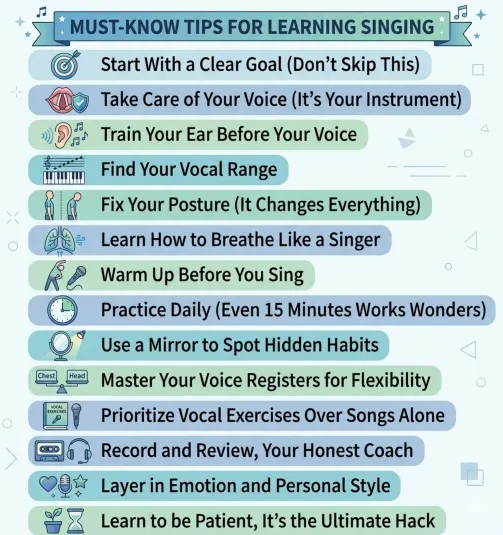
Must-Know Tips for Learning Singing
Start With a Clear Goal (Don’t Skip This)
Most beginners jump straight into singing songs. That’s where things go wrong. If you really want to learn to sing, you need direction. Instead of saying, “I want to sing better,” get specific:
- Improve your pitch accuracy
- Increase your vocal range
- Sing one complete song confidently
Break it into small, realistic steps. For example, choose a simple song, learn the lyrics, practice slowly, record yourself, and improve one section at a time. This makes your progress visible, and that’s what keeps you motivated.
Take Care of Your Voice (It’s Your Instrument)
Your voice isn’t just sound, but a part of your body. And like any instrument, it needs care. If you ignore vocal health while learning singing, progress becomes slow… or worse, you can damage your voice. Simple habits make a big difference:
- Drink enough water (hydration improves vocal clarity)
- Avoid shouting or forcing your voice
- Get proper sleep
- Warm up before singing
Pro Tip: pay attention to how your voice feels. If something hurts, you must stop. Singing should feel controlled and supported, not strained.
Train Your Ear Before Your Voice
One of the biggest struggles beginners face is pitch. You hear a note… but can’t match it. This is completely normal. Before you try to sing beautifully, train yourself to hear correctly. Start with a simple steps:
- Play a note
- Try to match it with your voice
- Repeat until you get closer
You can use apps or basic piano notes for this. Over time, your ear and voice start working together and that’s when real improvement begins.
Find Your Vocal Range
Not every song is meant for every voice. And forcing your voice into uncomfortable notes is one of the fastest ways to lose confidence. Your vocal range is simply the notes you can comfortably sing. Thus, once you know your range, you can pick the right songs and avoid strain. If a song feels too high or too low, adjust it or choose another one. Singing is all about how much you can adapt.
Here's a quick table for common types (use a piano app to test: Sing from comfy low to high without strain).
Fix Your Posture (It Changes Everything)
This might sound basic for learning singing, but it’s powerful. If your body is tense, your voice will be too. This is because your body affects your voice more than you think. Good posture helps you to control your voice and bring confidence. For better posture, follow these tips when standing:
- Feet shoulder-width apart
- Shoulders relaxed
- Chest open
- Head balanced (not tilted forward)
Learn some beginner friendly vocal exercises in the blog below!

Learn How to Breathe Like a Singer
Breathing is the foundation of singing. But most beginners breathe incorrectly. Instead of shallow chest breathing, you need deep, controlled breathing. The following tips can help you control your breath:
- Try to breathe in slowly
- Let your belly expand (not your chest)
- Exhale steadily while singing
Warm Up Before You Sing
You wouldn’t start a workout without warming up. The same goes for singing. A simple warm-up routine can include, Humming, lip trills, light scales. These help with relaxing your voice, improve flexibility and prevent strain. Remember, even 5–10 minutes daily can make a noticeable difference.
Here's a rewritten version that's more informative, packed with practical details, and written in natural, everyday language, like chatting with a friend who's passionate about singing.
Practice Daily (Even 15 Minutes Works Wonders)
Consistency is the key to becoming a successful singer. You don't need hours in the studio; 15-20 focused minutes a day builds real skills. Here's a quick routine to follow:
- Start with 2-3 minutes of deep breathing (inhale for 4 counts, hold for 4, exhale for 6) to relax your body.
- Do 3-5 minutes of warm-ups like humming scales or lip trills to wake up your voice gently.
- Spend 5 minutes on basic vocal exercises (more on those below).
- Practice one song section for 5 minutes, focusing on pitch and phrasing.
- End with a 2-minute cool-down, like soft sighs or gentle yawns.
How to learn singing at home? Follow this routine:
Use a Mirror to Spot Hidden Habits
This simple trick for learning singing is a game-changer most singers overlook. Stand in front of a full-length mirror while practicing to catch issues in real time:
- Check your posture: Feet shoulder-width, chest open, knees soft.
- Watch for tension: A clenched jaw, hiked shoulders, or forward head tilt strains your sound.
- Note mouth position: Keep it relaxed and open like a gentle yawn for better resonance.
Fixing these tweaks can instantly make your tone clearer and more powerful, no fancy gear needed.
Master Your Voice Registers for Flexibility
Every voice has "gears": chest voice that rich, grounded low range, like speaking loudly and head voice airy highs, felt in your skull. There's also a mixed voice, blending them for smooth transitions. Start with sirens and glide from low to high on "ng" or "oo" sounds. It might crack at first, but daily reps expand your range by 4-8 notes in a month.
Prioritize Vocal Exercises Over Songs Alone
Songs are fun, but targeted exercises are your foundation, like weight training before a big lift. They build control, range, and stamina. Try these starters:
- Lip trills or tongue trills on scales for smooth airflow.
- Arpeggios (do-mi-sol-do) to stretch your range.
- Sustained notes on vowels (ah/eh/ee) to strengthen breath support.
If it's tough, halve the speed and repeat. Repetition rewires your muscles for effortless power.
Record and Review, Your Honest Coach
It feels awkward hearing yourself at first (we all cringe!), but recordings reveal what your ear misses. Use your phone's voice memo app:
- Listen for pitch wobbles, breathy tones, or rushed phrasing.
- Compare week one to week four, you'll hear subtle gains in clarity and confidence.
Pro tip: Sing the same phrase daily and track improvements. It's faster feedback than any teacher.
Layer in Emotion and Personal Style
Technical skills get you notes; emotion makes you memorable. Once basics click, experiment:
- Vary dynamics (whisper to belt).
- Infuse feeling and sing heartbreak softly, joy with vibrato.
- Play with rhythm: Delay a note or add a scoop for flair.
This turns good singing into your signature sound.
Learn to be Patience, It's the Ultimate Hack
Signing progresses with time. There can be days where you may feel fatigue, suffer from cold, and distractions, but don’t fret. Be patient and follow all the tips that we have listed above. Remember, steady efforts take time to give you results.

How Spardha School of Music Can Help You Become a Singer
Spardha is a futuristic online music school offering live 1:1 classes for kids and adults, with a strong focus on singing, guitar, piano, violin, drums, and dance, all from home. The big idea is simple: replace random YouTube tutorials with a curated curriculum, certified teachers, and personalised musical journeys tailored to your age, skill level, and goals.
Because everything is online, you can learn to sing online from anywhere at your own pace, while still getting real‑time feedback and a proper learning path instead of “just winging it.”
Vocal / Singing Courses (How It Helps You Learn to Sing)
If your main focus is learning singing, Spardha offers structured vocal programs in:
- Western vocals – for pop, Bollywood, indie, and contemporary songs.
- Carnatic vocals – for classical South Indian style.
- Hindustani vocals – for North Indian classical and semi‑classical.
Each stream is available at beginner, intermediate, and advanced levels, so whether you’re starting from zero or already singing a bit, there’s a clear progression. You can even enrol for music certification courses if you’re serious about building a career or teaching in the future.
For singing‑specific courses, Spardha focuses on:
- Pitch accuracy and ear training.
- Breath control, posture, and vocal stamina.
- Range extension across chest and head voice.
- Song learning with professional feedback, not just random covers.
Spardha Vocal Courses Overview
Here’s a simple table summarising how Spardha fits your learning singing goals and keywords:
Final Thoughts
If you want to learn to sing seriously but still from home, Spardha is a smart “next step” after self‑practice. You keep the same habits, daily 15–20 minutes, warm‑ups, exercises, and recording yourself, but you add something crucial: structured guidance, real teachers, and a clear roadmap instead of guesswork.

Frequently Asked Questions
Can I learn singing at home?
Yes, you can learn singing at home with consistent practice, basic exercises, and the right guidance.
How long does it take to learn to sing?
It depends on your practice, but noticeable improvement can happen within a few weeks of regular training.
Do I need a good voice to start?
No. There’s no “bad voice”, only untrained voices.
What is the most important skill in singing?
Breath control and pitch accuracy are the foundation.