Table of Contents
Music is a universal language that speaks directly to our emotions, but understanding its basic building blocks lets passionate music learners grasp a deeper appreciation and skill in playing or creating it. Popular terms like pitch, tone, and scale form the base of music theory, yet they often confuse even experienced listeners and performers.
This comprehensive guide explores what is pitch, clarifies the difference between Pitch vs. Tone, examines various scales in music, and explains how tone in music shapes sound. The blog is especially for beginners, intermediate musicians, and curious listeners alike. Read on to learn more.
What is Pitch?
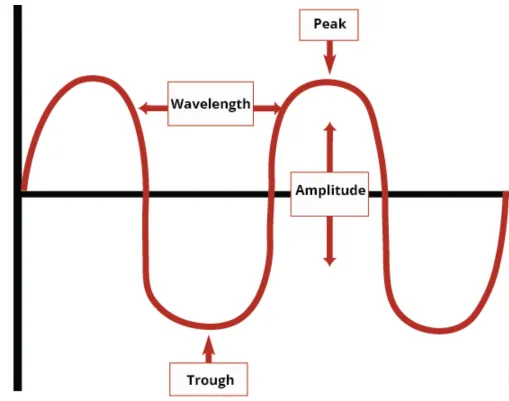
Pitch refers to how high or low a sound appears to the listener, determined by the frequency of its vibrations per second, measured in Hertz (Hz). A high pitch, such as the upper notes on a violin, results from rapid vibrations.
For example, the note A4 above middle C vibrates at 440 Hz, a standard tuning reference. Lower pitches, like a tuba's bass tones, vibrate more slowly, around 20-80 Hz at the bottom of human hearing. Understanding what is pitch helps beginners build a strong foundation before exploring tone and scales.
How Many Pitches Can We Actually Hear?
- The human ear can distinguish around 1,400 different pitches, stretching from the deepest rumbles we can hear all the way up to the highest squeaks!
- But when it comes to Western music, we work with a much more manageable system: just 12 distinct notes that repeat over and over, each separated by a semitone (the smallest step between notes).
- Musicians name these 12 pitches: C, C♯/D♭, D, D♯/E♭, E, F, F♯/G♭, G, G♯/A♭, A, A♯/B♭, and B. Those sharps (#) and flats (♭) match up perfectly with the black keys on a piano keyboard.
- Now here's the best part: even though the note names repeat every octave, each higher octave actually vibrates twice as fast as the one below it. That means the ratio between the top and bottom note of any octave is always 2:1.
- This is why you can instantly recognize that a low C and the next C up sound related, your ear has learned to hear that perfect doubling relationship.
- A standard piano's 88 keys cover just over seven octaves, cycling through those same 12 notes of the chromatic scale. Most orchestral instruments stick to similar ranges because the piano's highest note, C8, sits right near the upper edge of human hearing.
- Get this: when you play C8, that string vibrates 4,186 times per second! It pushes air molecules back and forth so fast that it creates waves of high-pressure "crowds" and low-pressure "gaps." Those waves hit your eardrum and make it vibrate along.
- Notes much higher than that (over ~4,100 Hz) get hard to perceive because our hearing system just can't keep up with the speed.
The Basics of Tone
The term "tone" actually serves two important purposes that often confuse beginners. First, it describes the interval or distance between two notes, specifically, a whole step. Take the notes D and E as an example: the gap between them spans a full tone, or whole step. On a piano keyboard, this means skipping one white key to land on the next white key, passing over a black key in between.
By contrast, the smallest possible distance between notes, a semitone or half tone, appears between notes like E and E-flat, where there's no key skipped at all; you simply move to the very next key, whether white or black.
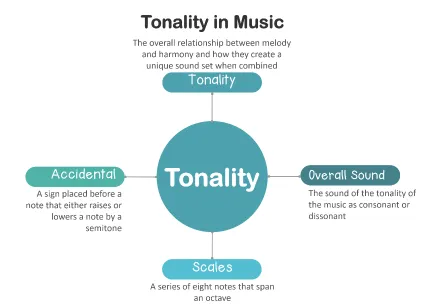
The second meaning of tone refers to individual notes or pitches themselves within a musical context. So when musicians mention "tones," they might mean specific notes like the E or D we've discussed. A complete collection of these tones, typically seven notes arranged in a particular sequence, forms what we call a scale, which defines the tonality or key of a piece.
For instance, the seven tones of C major (C, D, E, F, G, A, B) create a bright, uplifting sound, while the tones of A minor (A, B, C, D, E, F, G) lend a more somber mood.
What Contributes To Tone In Music?
The different tones in music doesn't just happen, it's created through several key elements working together. Here's a closer look at the main factors that give every note its distinctive character:
1. The Starting Point: Pitch
Everything begins with hitting the right note. Accurate pitch provides the foundation, get that wrong, and no amount of technique can save the tone. Knowing what is pitch at this stage helps musicians understand why intonation matters so deeply in performance.
Musicians with trained ears naturally navigate scales, instantly recognizing which pitches fit the harmonic context. This ear training becomes second nature during improvisation, where players instinctively choose notes that sound "right" within the chord progression.
2. Singer's Technique and Unique Voice
No two voices sound exactly alike, thanks to natural differences in vocal anatomy. The shape of your throat, mouth, nasal passages, and even chest cavity all act like a personal acoustic filter, giving every singer their signature sound.
3. Instrument Design and Playing Technique
Every instrument arrives with built-in tonal DNA:
Guitar offers endless variety:
- Where you pluck matters – bridge pickup gives bite, neck pickup warmth
- Acoustic vs electric – spruce tops ring bright, mahogany warms things up
- Playing style – fingerpicking yields intimacy, strumming adds attack
Piano shows subtler differences, but felt hammers vs synthetic, or grand vs upright, all influence sustain and clarity. Even touching the keys differently – delicate for sparkle, firm for depth, shapes tone.
4. Effects and Signal Processing
Modern music production produces infinite tonal possibilities through effects:
Guitarists chase "tone" obsessively:
- Jimmy Page (Led Zeppelin) combined Les Paul sustain with Marshall crunch for iconic bite
- The Edge (U2) uses sparse delay lines that make single notes fill stadiums
- Clean spring reverb evokes 60s surf; heavy distortion screams metal
Checkout 5 tips for singers to improve diction and pronunciation in the blog below!

Pitch vs. Tone: Key Differences and Why They Matter
The difference between pitch vs tone is fundamental yet frequently misunderstood. Pitch is objective and measurable – does the oboist hit A440 exactly? Tone is subjective and multifaceted, influenced by attack, decay, sustain, and release (ADSR envelope). Two oboes play the same pitch, but one player's embouchure creates a focused tone, another's a diffused one.
Understanding Scales in Music
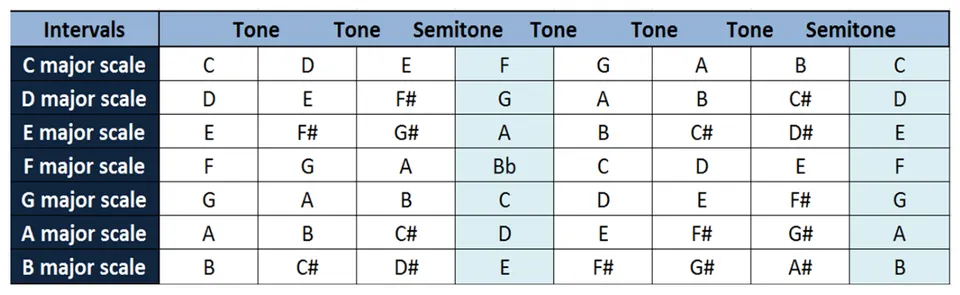
A scale in music is a stepwise arrangement of pitches serving as the basis for melodies and harmonies. Western music primarily uses diatonic scales (seven notes per octave) derived from the chromatic 12, with patterns of whole (W) and half (H) steps.
Common Types of Scales
Here's a list of scales in music, focusing on all types of scales in music most encountered:
- Major Scales (24 keys): Pattern W-W-H-W-W-W-H. C Major (C-D-E-F-G-A-B-C) sounds joyful. Each key adds sharps or flats (e.g., F# Major has six sharps).
- Natural Minor Scales: W-H-W-W-H-W-W. A Minor (A-B-C-D-E-F-G-A) feels somber.
- Harmonic Minor: Raises the 7th (G to G# in A Minor) for resolution tension.
- Melodic Minor: Ascends with raised 6th/7th (F#-G#), descends naturally.
- Pentatonic: Five notes (e.g., C-D-E-G-A). Ubiquitous in blues, folk, rock solos.
- Blues Scale: Pentatonic + flattened 5th (e.g., Eb in C Blues) for "blue notes."
- Chromatic Scale: All 12 semitones, used for modulations.
- Whole Tone Scale: Six whole steps (C-D-E-F♯-G♯-A♯-C), evokes floating ambiguity.
- Diminished Scale: Alternating whole/half steps, common in jazz.
Learn top vocal exercises to improve range and power of your singing!

Practical Applications and Learning Strategies
Understanding pitch, tone, and scales is one thing, applying them effectively takes focused practice. Here are practical, step-by-step approaches that help beginners build real musical skills:
Ear Training for Pitch Recognition
Start with interval training, which teaches your ear to recognize distances between notes. Apps like Functional Ear Trainer are excellent, guiding you to identify common intervals like the perfect 5th (think "Star Wars" theme opening) or major 3rd (first two notes of "Oh When the Saints"). Begin with simple major/minor seconds, gradually working up to trickier augmented fourths. Practice 10 minutes daily, soon you'll hear chord progressions instinctively while listening to your favorite songs.
Reading Pitch on Sheet Music
Learn staff landmarks first before memorizing every line. For treble clef, the five lines from bottom to top spell E-G-B-D-F ("Every Good Boy Does Fine"). Spaces spell F-A-C-E. Bass clef lines are G-B-D-F-A ("Good Boys Do Fine Always"), spaces A-C-E-G. These mnemonics anchor your reading – other notes become "steps" or "skips" from these landmarks. Practice sight-reading simple melodies using just these guideposts rather than hunting each note name individually.
Developing Consistent Tone
Record yourself playing or singing daily scales , phone voice memos work fine. Listen back objectively: Is the tone breathy and unsupported? Aim for consistency across your range first, then refine for character. Instrumentalists should experiment with point of contact, guitarists try bridge vs neck pickup positions; wind players adjust air stream angle. Vocalists practice vowel shaping ("ahh" for openness, "ee" for focus).
Mastering Scales Systematically
Don't jump randomly between scales. Follow the circle of 5ths progression: start with C Major/A minor (no sharps/flats), advance to G Major/E minor (one sharp), D Major/B minor (two sharps), and so on. This builds muscle memory for finger patterns while teaching accidentals naturally. Practice each scale hands separately, then together, one octave first, then two octaves. Use proper fingering from day one (1-2-3 pattern for right hand major scales). Aim for even tone and tempo before adding dynamics or speed.
Don’t Forget to Practice
Play a C Major scale while singing solfege (do-re-mi), record to check pitch accuracy and tone consistency. Analyze favorite songs, identify the key (scale), main intervals in melody, and tone color choices. This bridges theory to real music-learning.
Want to Learn More About Music?
If you’re ready to develop your voice to be a great singer, reach out and sign up for online singing classes with Spardha School of Music. We have professional instructors providing step-by-step lessons with personalised feedback, perfect for beginners building confidence or intermediates refining technique.
Start your musical journey with expert guidance that makes theory practical and performance achievable.
Explore some beginner friendly vocal exercises in the blog below!

Frequently Asked Questions
What is the difference between pitch and tone in music?
Pitch determines how high or low a note sounds (frequency), while tone describes its quality or timbre, like how a guitar differs from a piano playing the same note.
How many scales are there in music?
Western music features 12 major scales, 12 natural minor scales (plus harmonic/melodic variations), pentatonic, blues, chromatic, whole tone, and diminished scales, plus 7 modes per key.
What are the 12 tones in music?
The chromatic scale: C, C♯/D♭, D, D♯/E♭, E, F, F♯/G♭, G, G♯/A♭, A, A♯/B♭, B – repeating every octave.
How can I improve my tone when singing or playing?
Practice long tones for consistency, record yourself for self-assessment, experiment with breath support/vibrato (singing) or articulation/position (instruments), and study great performers in your style.