Table of Contents
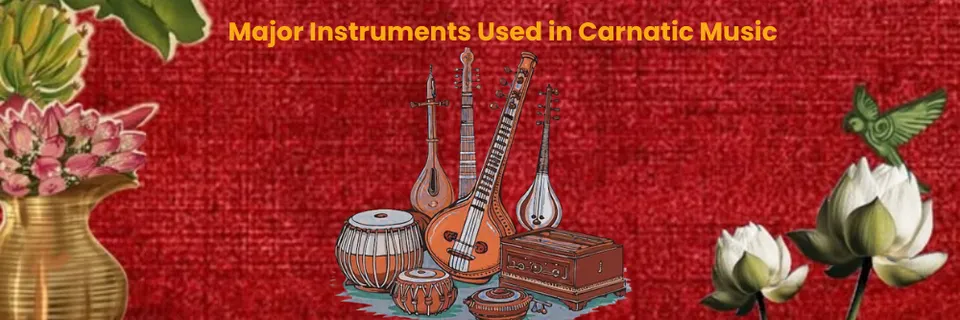
Carnatic music instruments form the heart of South Indian classical music, creating rich sonic textures that have mesmerized audiences for generations. Understanding carnatic music instruments is essential for appreciating this ancient musical tradition. These instruments include melodic, percussion, and drone types, each working in perfect harmony to create profound musical experiences.
Introduction to Carnatic Music Instruments
The world of carnatic music instruments features diverse textures and sounds - from the resonant veena strings to the powerful mridangam rhythms. Each instrument among these contributes uniquely to performances. Learning about carnatic music instruments opens doors to understanding one of the world's most sophisticated classical music systems, where every carnatic music instrument has a specific role and purpose in the ensemble creating harmonious musical expressions.
Explore best traditional Indian Musical Instruments in the blog below!

String Instruments in Carnatic Music
String carnatic music instruments provide melody and harmonic support in classical performances, forming the melodic backbone.
Tanpura
The tanpura is a fundamental drone carnatic music instrument providing a continuous harmonic foundation for all ragas.
The tanpura creates the essential harmonic foundation from which all ragas derive their distinctive character. Modern musicians often use electronic shruti boxes, though traditional instruments remain preferred by purists for their authentic sound quality.
You can explore Spardha’s online Tanpura as well to develop an understanding of its sound and how to practice with it.
Veena
The veena is among the most revered carnatic instruments, named after goddess Saraswati. This fretted lute produces three-octave range.
Veena Specifications:
The veena allows characteristic gamakas essential to Carnatic music. Carved from a single wood block, it has a resonator for tuning.
Players use left hand for frets, right hand for plucking.
Violin
The violin is unique among carnatic musical instruments - a Western instrument completely adapted to Indian classical traditions. Introduced by Baluswamy Dikshitar (brother of composer Muthuswamy Dikshitar) during the 18th-19th century, it became the primary melodic accompaniment.
Carnatic Violin:
- Playing Position: Cross-legged with scroll resting on right ankle
- Technique: Sliding and gliding to imitate vocal gamakas
- Role: Both accompaniment and solo performances
- Tuning: Perfect fifths (G3, D4, A4, E5)
The violin suited Carnatic music perfectly because gamakas were natural and intuitive on this instrument. It evolved from melodic support in Harikatha performances to devotional music concerts, eventually becoming the best possible melodic accompaniment owing to its continuity, sound reproduction capacity, and adaptability.
Percussion Instruments in Carnatic Music
Percussion carnatic music instruments provide rhythmic foundation and performance energy, driving the musical momentum.
Mridangam
The mridangam is the most important percussion among carnatic music instruments. This ancient drum provides primary rhythmic accompaniment, essential to performances.
Mridangam Construction:
Basic Strokes: Tha (non-vibrating palm tone), Dhi (center black portion), Thom (vibrating left bass), Nam (vibrating right tone).
The mridangam defines seven talas: Dhruva, Matya, Rupaka, Jhampa, Triputa, Ata, and Eka.
Ghatam: The Clay Pot Percussion
The ghatam is a unique clay pot among carnatic instruments, literally meaning 'pot' in Sanskrit.
Elements: Five elements (Pancha Bhutas) - Earth, Fire, Water, Air, Space - create this instrument. Players use all ten fingers on the mouth, slanting portion, and lower half to create varied sounds.
The ghatam produces different pitches based on size. It can be re-tuned using clay or by wetting to adjust pitch.
Morsing
The morsing is a metal jaw harp among carnatic music instruments with horseshoe-shaped frame and vibrating tongue.
Playing: Placed on teeth, struck with finger, pitch changed by tongue movement and nasal sounds. The technique aids meditation. Used since Ramayana period as "Dhantha Vadhyam."
Wind Instruments in Carnatic Music
Checkout some famous flute players of India in the blog below!

Venu (Bamboo Flute)
The venu or bamboo flute is among the most ancient carnatic musical instruments, associated with Lord Krishna and mentioned in Natya Shastra. This side-blown transverse flute is a key-less aerophone discussed as an important instrument in ancient Sanskrit texts.
Venu Specifications:
Adaptations: The flute was modified for Carnatic music through innovations by Sharaba Shastri and T.R. Mahalingam (Flute Mali). Key modifications included: addition of the 7th hole, use of thicker-walled bamboo, and technique of lifting head to change embouchure angle when shifting between notes. These innovations enabled performance of Carnatic ragas with all necessary gamakas and ornamentations without losing the raga's essence. The venu is monophonic like a human voice with typical two and half octave reproduction.
Read about different Musical Instruments in the blog below.

The Role of Each Instrument in Carnatic Ensemble
Carnatic music instruments work together in a structured ensemble. Understanding how these instruments used in carnatic music complement each other enhances appreciation.
Typical Ensemble Structure
Performance Format
A traditional Carnatic concert (kutcheri) typically lasts 2-3 hours and follows a structured format. The performance begins with a varnam (melodic exploration), followed by kritis (main compositions), alapana (raga introduction), kalpanaswaram (improvisation), ragam-tanam-pallavi (RTP), tani avartanam (percussion solo), and concludes with thillana. Each section showcases different carnatic music instruments and their unique capabilities, demonstrating the versatility of each carnatic music instrument in the ensemble.
Historical Context
The present-day format developed during King Ragunath Nayak's 17th-century reign. Three contexts emerged: royal courts, temples, and dance accompaniment. This heritage influences modern performances.
Learning Carnatic Music Instruments at Spardha School of Music
Mastering carnatic music instruments requires dedicated practice and expert guidance. Spardha School of Music offers comprehensive training in various carnatic music instruments for all skill levels.
Why Choose Spardha for Carnatic Instruments?
We understand that learning instruments used in carnatic music demands personalized attention. Our instructors provide:
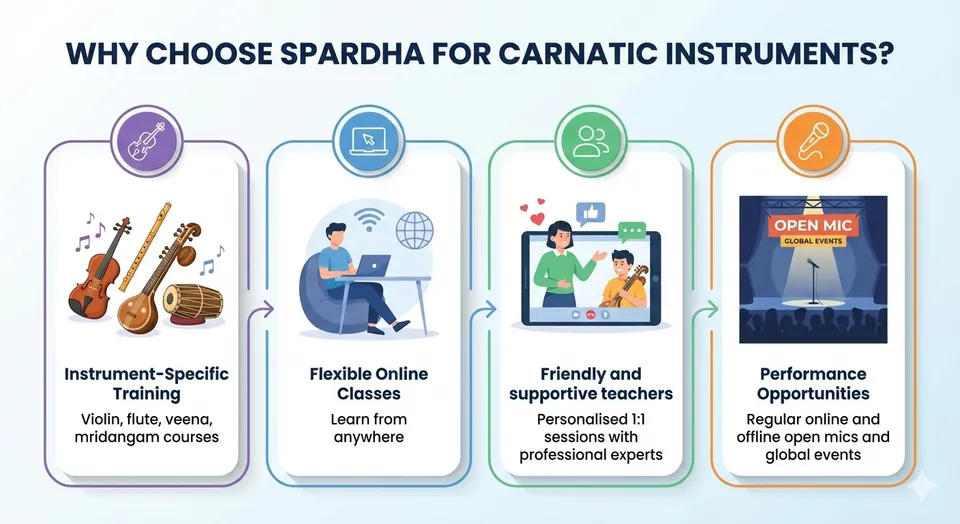
- Instrument-Specific Training: Violin, flute, veena, mridangam courses
- Flexible Online Classes: Learn from anywhere
- Friendly and supportive teachers: Personalised 1:1 sessions with professional experts
- Performance Opportunities: Regular online and offline open mics and global events
Whether interested in veena, mridangam, or Carnatic violin, Spardha School provides the perfect environment. Start your journey today - Book a free trial class!
Conclusion
Carnatic music instruments represent centuries of musical evolution and rich cultural heritage. From the divine veena to the powerful mridangam, each instrument among these carnatic music instruments contributes uniquely to South Indian classical music's tapestry.
Understanding carnatic music instruments deepens appreciation for this sophisticated art form. The seamless integration of string, percussion, and wind carnatic music instruments creates complete experiences that are intellectually stimulating and emotionally moving.
Whether drawn to melodic or rhythmic instruments used in carnatic music, each offers lifetime learning opportunities. With dedication and proper guidance from institutions like Spardha School of Music, anyone can master these beautiful instruments and become part of this living musical tradition that continues to evolve while maintaining traditional essence.
Frequently Asked Questions
1. What are the main instruments used in Carnatic music?
The main instruments are tanpura (drone), mridangam (primary percussion), violin (melodic accompaniment), veena (string instrument), flute (wind instrument), ghatam and morsing (secondary percussion).
2. What is the role of the mridangam in Carnatic music?
The mridangam serves as the primary rhythmic accompaniment, maintaining the tala (time cycle) and providing the foundational beat that drives the entire performance forward.
3. How does the violin fit into Carnatic music despite being a Western instrument?
The violin was adapted in the 18th-19th century and proved perfect for Carnatic music because it can naturally produce gamakas (glides and oscillations), which are essential to the music's expressive character.
4. How can I practice Carnatic music instruments online?
You can learn Carnatic instruments online through platforms like Spardha School of Music, which offers one-on-one instruction with experienced teachers, flexible scheduling, and comprehensive curriculum for various instruments.