
Table of Contents
Quick Summary
Sargam Geet is a structured vocal composition in Hindustani classical music that uses musical notes - Sa, Re, Ga, Ma, Pa, Dha and Ni—instead of lyrical words. Also known as Swarmalika, it combines the melodic patterns of a raag with a rhythmic cycle called taal. Its two main sections, Sthayi and Antara, help students practise pitch accuracy, rhythm, raag recognition and melodic movement. For beginners, Sargam Geet provides a practical foundation for understanding classical vocal music.
What is Sargam Geet?
In Indian Classical Vocal Music, mastering a raag requires a pre-requisite training on its basic movement of notes, which is termed as Chalana or Pakad to understand it’s uniqueness and its basic structure and here, a music form assists the students of music to master it and it’s termed as sargam geet.The word “ Sargam’ is a connotation created by the combination of the first four letters of the swaras in our usual “Sa Re Ga Ma Pa Dha Ni Sa”, where only ‘Sa Re Ga Ma’ (Shadaj Rishabh Gandhar Madhyam) note’s wordings are used. While the usual swaravali consists of seven basic sounds of sargam in total but in a sargam geet, the notes are inter-twined into a structured and unique melody.
Sargam Geet is also called as “swarmalika” “suravarta” or “suravartana” is a basic form in Hindustani classical vocal music. It is built around the swar or “solfège” of a particular “raag” and follows a fixed rhythmic cycle, known as “taal”.
Historical Evolution of Sargam geet
Traditionally, the genre of Sargam Geet has been passed down from generation to generation by hereditary musicians in the Guru-Shishya Parampara style. In the latter half of the nineteenth century, Sargam Geet started to be performed in students' public exhibitions by bodies such as the Parsi Gayan Uttejak Mandali of colonial Bombay (established 1870). It is interesting to note that although Sargam Geet has become an integral part of institutional syllabuses, the professional vocalist did not include this genre within his or her concert repertoire at all, considering it only as riyaaz (practice).
Structure and Anatomy of a Sargam Geet
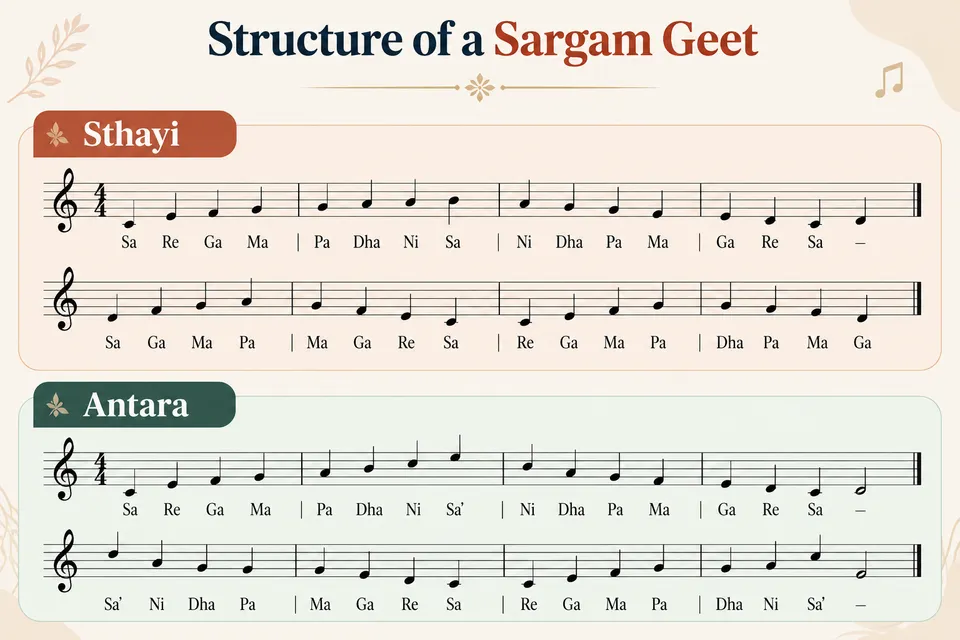
A typical sargam geet is composed in a specific rhythmic cycle or taal, and teentaal, which is a 16 matra taal with three talis and one khali, is popular. Sargam in music is basically the structure without the taal, but when it is sung in the form of a geet, a song, it takes the form of a bandish-like composition. This music form is composed of two stanzas :-
- Sthayi (first stanza) : It is the opening section of the composition , which introduces the core melody of the raag and stays primarily within the range of Mandra Saptak (Lower octave) and Madhya Saptak (Middle Octave). It is a prologue.
- Antara (second stanza) : Followed by sthai, in sargam geet, this is the second part where the melodic structure of the raag is represented in the Tar saptak (upper octave) range and this is the transition phase of the composition, allowing the artist to showcase the contrast.
Role of Taal in the Sargam geet
- Sargam geet is not just a loose connection of notes or sargam in music. It is a calculated and framed composition made according to the rhythmic structure (taal) and tempo (laya) , as mentioned before.
- In sargam geet, the seven basic sounds of sargam are frequently set to the taal (time cycles) called Teental, which is of 16 matras or sometimes it is based on Keherwa taal, which is of 8 matras .
- Developing Rhythmic Accuracy: Practicing within a taal trains beginners to align note phrases precisely with individual beats (matras) and sectional divisions (khand / vibhag), instilling strong rhythmic discipline early in their musical journey.
Teaching the Grammar of the Raag
- A raag in Indian classical music theory, traditionally known from the ancient Sanskrit dictum, "Ranjayati Iti Raag", means that the basic purpose of this phenomenon is to entertain and evoke emotions in a listener through the use of musical notes arranged in accordance with certain laws. As different from any simple scale, a raag is a complex live framework of musical notes, governed by very strict rules, including the requirement to have at least five notes and definite ways of ascendance and descendance. Learning all these complicated rules might become a hard task for a beginner, which is why the concept of sargam geet becomes extremely useful, providing an essential way of incorporating basic rules of a raag into a vocal practice without distracting attention with a song text or lyrics.
- Apart from the static scales, Sargam Geet gives voice to a raag's Chalan - the specific melodic progression that defines the movement of the melody in that particular raag and its Pakad, i.e. the distinctive note combinations and melodic phrases used to vocalize and instantly convey the character of that particular raag. Moreover, sargam Geet vividly demonstrates the tonal gradation of the raag, emphasizing its Vadi Swar (the most important "king" note of the raag) and Samvadi Swar (the secondary, but still essential "queen" note of the raag) and explaining the role of the rest of Anuvadi-Swaras. On the other hand, practicing Sargam Geet teaches the vocalist to carefully avoid Varjya Swaras (or Varjit swaras) - the notes prohibited in the particular raag. In this way, by interweaving these basic principles into an orderly and rhythmical melody, Sargam Geet converts the abstract notions into a practical musical experience, laying down a strong foundation for beginners in pitch perception and raag identification.
The 5 Major Pedagogical Benefits for Beginners
- Pitch Precision (Swara Sthan) - In vocal music, accuracy of pitch is very important. By getting rid of poetry in the song-text and concentrating solely on the naming of notes (Sa, Re, Ga, Ma, Pa, Dha, Ni), Sargam Geet takes away all language distractions. It demands that the singer be able to accurately perform pitch intervals using notes, flat notes, and sharp notes. The practice of performing the solfège exercises enables a singer to accurately sing the note positions and make clean transitions, which forms the basis for vocal ornamentations.
- Internalizing Rhythm, Tempo, and Timekeeping (Taal & Laya) – The two basic principles of Indian classical music include pitch and rhythm. There are many types of Sargam Geet compositions which are based on rhythmic time cycles or taals including Teentaal (16 beats) and Keharwa (8 beats) at various tempos (laya). Singing note combinations over beats (matras) and sections (khands) helps students in learning to recognize important rhythmic elements, particularly the ability to land at the start point of an emphasized beat (Sam '×') and to recognize an unemphasized wave beat (Kaal '0').
- Superior Ear Training & Raag Recognition - One of the major aims in classical training is the development of Kelvi Gyanam – the practice of active listening. Repeated singing of Sargam Geet helps students learn the sound pattern, body language, and phrases characteristic of a particular raag. When new singers get acquainted with the patterns of notes, their mind automatically converts them into solfeggio notation (for instance, distinguishing between melodies like Sa-Sa-Pa-Pa-Dha-Dha-Pa). This conversion allows singers to recognize various raags while listening to classical performances and light music songs.
- Holistic Mental Growth through Cognitive Development, Concentration, and Mathematical Ability - The study of classical vocals acts as an effective stimulant for holistic mental development. The ability to work out swaras in different patterns within given rhythms is quite a mental task, which helps increase concentration levels and improves memory as well. Also, Indian classical rhythms are mathematical in nature; the counting of beat patterns and note placement sharpens logical abilities and pattern analysis skills.
- Stress Reduction, Breathing Control, and Vocal Cord Health - Apart from proficiency in music, there are numerous physiological and psychological benefits attached to singing the Sargam Geet. This involves controlled breathing of the diaphragm muscle, breathing in slowly through the nose, and controlling the release of the voice, an activity that helps calm the nervous system in the same way yoga and meditation do. This helps in developing strong vocal cords and also enhances the vocal capacity of the singer.
Warm-Up Exercises Prior to Practicing
Successful practice starts with body and vocal warm-up exercises. These exercises precede the singing of Sargam Geet:
1. Body warm-up: Warm up the upper body by doing shoulder rolls and massaging the face especially jaw area and relaxing the neck area.
2. Posture: Adopt an upright position sitting in a cross-legged position on the floor or in a chair.
3. Breathing: Learn to breathe slowly using the abdomen breathing technique.
4. Vocal warm-up: Do humming exercise on the note of Sa.
Vocal Health and the Importance of the Guru
Vocal longevity depends on healthy living practices and skilled teaching. Singers must remain hydrated by drinking room-temperature water and must not consume too much dairy and coffee that create phlegm or dehydrate the body, but they must also include honey, ginger, and turmeric in their diet. Sufficient sleep and the avoidance of throat clearing ensure the safety of the vocal cords. Most importantly, although self-practice is good for understanding sargam in music, the teachings of the guru are necessary to correct any vocal errors.
Case Studies for Foundational Raags
- Raag Bilawal: Classified as a Sampoorna jaati raag (raag that uses all the seven notes both in ascending and descending order) with Dha as Vadi and Ga as its Samvadi, Bilawal uses all pure notes. The Sargam Geet of Raag Bilawal acts as the perfect foundation for training children with regards to basic pitch accuracy.
- Raag Bhoopali: This raag is a pentatonic raag of Odav-Odav jaati which belongs to Kalyan Thaat, Raag Bhoopali leaves out Ma and Ni and uses five notes i.e. Sa, Re, Ga, Pa, Dha with Ga as Vadi and Dha as Samvadi. A usual Sargam Geet in Bhoopali set to Teentaal (16 beat) is used to teach students about dealing with 4-beat khands within Sthayi and Antara.
- Raag Kafi & Raag Yaman: As students advance in their learning process, Sargam Geets teach them the usage of altered notes. For example, Raag Kafi uses the flat notes such as Komal Ga and Ni, Raag Yaman on the other hand teaches them to sing the sharp Ma (Tivra Ma) set to Teentaal.
Conclusion
To summarize, Sargam Geet, known differently depending on the tradition of classical music, is not only a simple vocal exercise . It is a true pedagogical link between the patterns of scales (alankars) and sophisticated classical compositions like chota khyal and bandish. Disengaging from poetic lyrics, this technique concentrates exclusively on the seven fundamental sounds of sargams which allows for transforming complicated theoretical laws of raag into a musical learning process. Singers can acquire all the necessary elements of raag, including-ascending and descending paths (aaroha and avroha), melodic movement (chalan) and peculiar combinations of sounds (pakkad).
Apart from being a guide to the rules of raag, Sargam Geet teaches the most important techniques for lifelong development in the sphere of art. Solfège singing according to the time cycle (taal) develops the perfect intonation (swara sthan) and precise timekeeping (laya) that are regarded as the mother and father of music. Moreover, it fosters the ability of disciplined listening which lets singers understand melodic lines in mind, recognize different raags performed by other artists, and make smooth transition to improvisation.
Frequently Asked Questions
What is sargam geet in music?
Sargam geet is a musical composition in Indian classical music where the lyrics are replaced by musical notes (sargam). It is also known as Swar Malika or Suravarta. Instead of using poetic words or lyrics, the singer performs the melody using the fundamental notes - Sa, Re, Ga, Ma, Pa, Dha, Ni.
What is sargam called in English?
Sargam is called solfège or musical notes in English. It is the Indian equivalent to the Western Do-Re-Mi system. The word sargam comes from the first four notes: Sa, Re, Ga, Ma. The full set of seven basic notes (swaras) in an octave corresponds to Western solfège like this:
• Sa = Do (Shadja)
• Re = Re (Rishabha)
• Ga = Mi (Gandhara)
• Ma = Fa (Madhyama)
• Pa = Sol / So (Panchama)
• Dha = La (Dhaivata)
• Ni = Ti / Si (Nishada
What is called sargam?
Sargam is the traditional system of naming and singing the seven basic musical notes in Indian classical music. The notes form the structural foundation (the saptak or octave) for all Indian melodies, scales, and vocal exercises.
How to learn Sargam?
To learn sargam, start by memorizing the seven basic musical notes (swaras) and practicing them daily with a steady drone or Tanpura App.
