Table of Contents
The time theory of ragas is one of the most fascinating aspects of Indian classical music, setting it apart from musical traditions worldwide. According to the time theory of ragas, specific ragas are associated with particular times of day and night, creating a profound connection between music and natural cycles. This ancient practice ensures that each raga evokes the appropriate mood when performed at its designated time.
Understanding the time theory of ragas is essential for students and performers. The theory suggests that performing ragas at prescribed times helps create their specific emotional expression. This temporal association, based on centuries of observation, has been followed since the Vedic period.
Understanding the Raga Time Chart
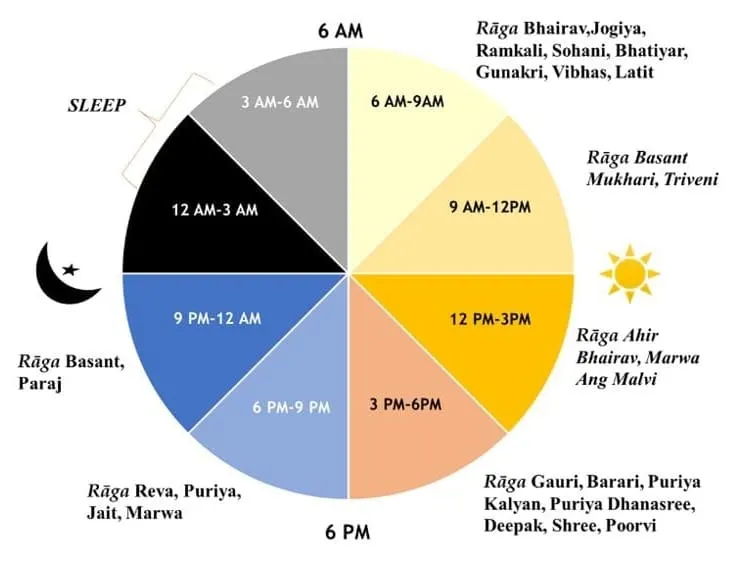
A comprehensive raga time chart serves as an essential reference for musicians and students studying Indian classical music. The chart divides the 24-hour day into specific periods, assigning ragas based on their emotional characteristics and tonal qualities. Musicians have relied on such charts for centuries to ensure authentic and emotionally resonant performances.
Complete Raga Time Chart
This raga time chart represents the traditional division used by classical musicians across India for generations. The raga timings are carefully calibrated to align with the natural progression of the day, ensuring that the emotional content of each raga resonates with the listener's state of mind at that particular hour.
Historical Development of Time Theory of Ragas
The historical development of time theory of ragas traces back thousands of years to ancient India, representing one of the world's oldest systematized musical practices. The time theory of ragas was already well-established during the Vedic period, demonstrating its integral role in India's cultural and spiritual heritage.
Vedic Period Foundations
During the Vedic era, the foundation of what would become the time theory of ragas manifested in the recitation of sacred hymns at specific times of day:
- Morning: Vedas chanted using lower chest notes to match the calm dawn atmosphere
- Noon: Throat register employed for the brightness of midday
- Evening: Higher notes (tharasthayi swaras) utilized as day transitioned to night
This systematic approach to temporal music laid the groundwork for the sophisticated time theory of ragas we know today. The ancient seers understood that different voice registers and melodic patterns resonated differently depending on the time of day.
Evolution Timeline
The historical development of time theory of ragas in Hindi and other regional traditions shows fascinating evolution across centuries. Before the bifurcation of Indian classical music into Hindustani and Carnatic systems, ragas were classified in various ways. One significant classification divided ragas into male (raga) and female (ragini) categories, each with specific time associations. Ancient musicologists noticed that certain melodic patterns and note combinations naturally suited specific times of day, leading to the comprehensive codification we follow today.
Explore the blog below to know the swaras in Carnatic Music!

Time Classification Systems in Indian Music
The time theory of ragas employs multiple classification systems, providing clear guidelines for raga timings.
Primary Time Divisions
Understanding these divisions is crucial for applying the time theory of ragas in performance.
Ancient Tamil Music and Time Theory
The time theory of ragas was equally prominent in ancient Tamil music. Tamil texts from the 1st-2nd centuries CE contain detailed descriptions of ganakala niyamas (time rules).
Tamil Pann System
Tevaram Classification
The Tevaram tradition classified 24 panns into three temporal categories:
This ancient system demonstrates that the time theory of ragas was independently developed across Indian traditions.
Hindustani Music Time Theory System
The Hindustani tradition credits Pandit V.N. Bhatkande (1860-1936) with systematizing the modern time theory of ragas. His work categorized ragas based on vadi-samvadi relationships and time divisions.
Purvanga and Uttaranga Classification
A crucial aspect of the time theory of ragas involves the Purvanga-Uttaranga system, dividing both the octave and the day.
Time and Octave Division
24-Hour Division:
- First Half (Noon to Midnight): Purva Ragas
- Second Half (Midnight to Noon): Uttara Ragas
Octave Division:
- Purvanga: Sa, Re, Ga, Ma
- Uttaranga: Pa, Dha, Ni, Sa
Examples:
- Khamaj (Vadi: Ga) - Purvanga Vadi - Performed noon to midnight
- Bhairav (Vadi: Dha) - Uttaranga Vadi - Performed midnight to noon
This system provides musicians with a logical framework for determining performance times.
Learn more about the king of Ragas in Carnatic Music in the blog below!

Evening Ragas and Specific Time Periods
The evening ragas list holds special significance as evening performances are traditionally most popular. The transition from day to night creates unique atmospheric conditions.
Evening Ragas List
Early Evening (6:00-8:00 PM):
Late Evening (8:00-10:00 PM):
The evening ragas list demonstrates how the time theory of ragas calibrates musical moods to match listeners' emotional states.
Sandhiprakasa Ragas: Twilight Melodies
Sandhiprakasa ragas represent a unique and important category within the time theory of ragas, performed specifically during twilight periods - dawn and dusk - when day and night meet. These transitional times hold special significance in Indian philosophy and music.
Characteristics:
- Contain komal (flat) Re and Dha swaras
- Performed during transitional twilight times
- Create contemplative and meditative moods
- Associated with spiritual practice and inner reflection
Examples:
- Bhairav - Dawn (5:00-7:00 AM) - Majestic and devotional
- Ahir Bhairav - Dawn - Mixed emotions
- Marwa - Late afternoon/early evening - Serious and contemplative
These ragas occupy a special place in the time theory of ragas, representing moments of transformation and transition between light and darkness.
Take this below quiz to know if you're improving in Carnatic singing!

Learning Time Theory at Spardha School of Music
Mastering the time theory of ragas requires dedicated study, consistent practice, and expert guidance from experienced teachers. Spardha School of Music offers comprehensive training in both Hindustani and Carnatic music, with special emphasis on the time theory of ragas and proper raga timings.
Why Choose Spardha?
At Spardha, we recognize the importance of flexible schedules, consistent practice and performance opportunities. Our online 1:1 personalised classes under the guidance of professional and friendly teachers ensure that you get specialised attention and stay motivated. Spardha also offers multiple performance opportunities throughout the year to help you gain confidence in your new skill.
Whether studying for performance or academic interest, Spardha provides the perfect environment for learning the time theory of ragas across both major Indian classical traditions. Start your journey today - Book a free trial class!
Modern Relevance of Raga Timings
While the time theory of ragas originated in ancient times, its relevance continues today. Modern musicians balance tradition with practical constraints.
Value of Time Theory:
- Preserves traditional knowledge
- Enhances emotional impact
- Maintains natural cycle connections
- Provides insights into raga character
Modern Applications:
- Traditional concerts follow raga timings
- Students practice ragas at appropriate times
- Music therapy applies time theory principles
- Recording sessions planned by raga character
Most agree that understanding the time theory of ragas remains essential for authentic interpretation.
Conclusion
The time theory of ragas represents one of Indian classical music's most sophisticated features. This ancient system creates a profound connection between music, nature, and human emotion. From the comprehensive raga time chart to the beloved evening ragas list, the time theory of ragas enriches every aspect of Indian classical music.
Understanding the historical development of time theory of ragas deepens appreciation for this art form. Whether examining ancient Tamil panns or modern Hindustani classifications, the principle remains constant: certain melodic patterns naturally resonate with specific times.
The time theory of ragas continues to evolve while maintaining its traditional core. Modern musicians balance respect for raga timings with practical considerations. Institutions like Spardha School of Music transmit this knowledge to new generations, keeping the time theory of ragas alive.
As you explore Indian classical music, the time theory of ragas offers endless fascination. Each time period brings special ragas, each evoking unique moods, creating a complete musical experience that honors natural rhythms of life. The time theory of ragas reminds us that music is deeply intertwined with our daily experience of time and consciousness.
Frequently Asked Questions
1. What is the time theory of ragas in Indian Classical Music?
The time theory of ragas is a system that associates specific ragas with particular times of day and night, ensuring that each raga is performed when it can best evoke its intended mood and emotional response.
2. What are the ragas according to time?
Ragas are classified into morning ragas (like Bhairav, Asaveri), afternoon ragas (like Saranga, Kaphi), evening ragas (like Yaman, Puravi), and night ragas (like Kamas, Malkauns), each performed at specific times for optimal emotional impact.
3. What's the historical development of time theory of ragas?
The time theory developed during the Vedic period with time-specific hymn recitation, evolved through ancient Tamil pann classifications, and was systematized in modern times by musicologists like Pandit V.N. Bhatkande.
4. Is time theory of ragas still relevant today?
Yes, the time theory remains relevant as it provides deep insights into raga characteristics and emotional content, though modern concerts sometimes adapt strict timing rules due to practical performance constraints.